


ClawCrazy: Play, Grab & Win
CoinCrazy
I went into ClawCrazy: Play, Grab & Win expecting a quick arcade distraction, and that is exactly where its appeal is strongest. It puts the familiar claw-machine idea on a phone, then adds the possibility of winning real rewards. The result feels more immediately interesting than a standard score-chasing game because every attempt seems to have a purpose beyond filling a progress bar.
That promise also creates a different kind of responsibility for the player. This is not simply a relaxing game that I can judge by controls, graphics, and level design. I also have to ask whether the excitement survives after the first few sessions, whether the reward-focused format remains enjoyable when luck goes against me, and whether it deserves regular attention rather than a brief installation followed by deletion. My answer is positive, but qualified: it is a lively arcade experiment for the right player, not an automatic replacement for a traditional game.
Why the first week feels so appealing
The opening appeal comes from the physical idea behind the game. A virtual crane is easy to understand without a tutorial-heavy introduction: choose an opportunity, operate the machine, and see whether the grab works. That simplicity matters on a phone. I could pick it up for a short break without first learning a complex control scheme, a large map, or a long list of character abilities.
The reward angle gives each round more tension than an ordinary digital claw game. In a conventional arcade title, missing the prize usually means losing points or needing another attempt. Here, the possibility of an actual reward makes me pay closer attention to the timing and outcome. Even when the action is brief, the anticipation stretches the moment. That is a clever way to make a small interaction feel more significant.
It also helps that the game is presented as an online arcade rather than as one isolated machine. The broader framing gives the experience some variety and makes it feel less like a single repetitive toy. I would not describe it as a deep arcade collection, because the central attraction remains the claw-machine format, but the online setting gives the product a stronger identity than a basic offline imitation.
Related News






During an ordinary day, I can imagine using it while waiting for a bus, taking a short lunch break, or winding down before bed. The important distinction is that it works best as a contained activity. I would open it with the intention of playing for a few minutes, not expecting a long session with a story arc or a carefully escalating campaign. That makes it particularly suitable for people who enjoy compact bursts of suspense.
The game is free to install, which lowers the barrier to trying it. Its listing shows an average rating of 4.8 from roughly twelve thousand ratings, and that suggests the central concept has connected with a substantial audience. I still would not treat a high rating as proof that every player will enjoy the reward system. People who dislike chance-based arcade experiences may find the same feature that excites others frustrating.
The controls are simple, but the decision-making is not always simple
One useful way to approach the first week is to resist the urge to treat every attempt as equally valuable. The temptation is to play immediately whenever an opportunity appears, especially when the interface makes the next action feel close at hand. I found it more sensible to pause and decide whether I was playing for entertainment or chasing a particular result. Those are different goals, and confusing them can make the experience feel more expensive or more stressful than it needs to be.
Gallery
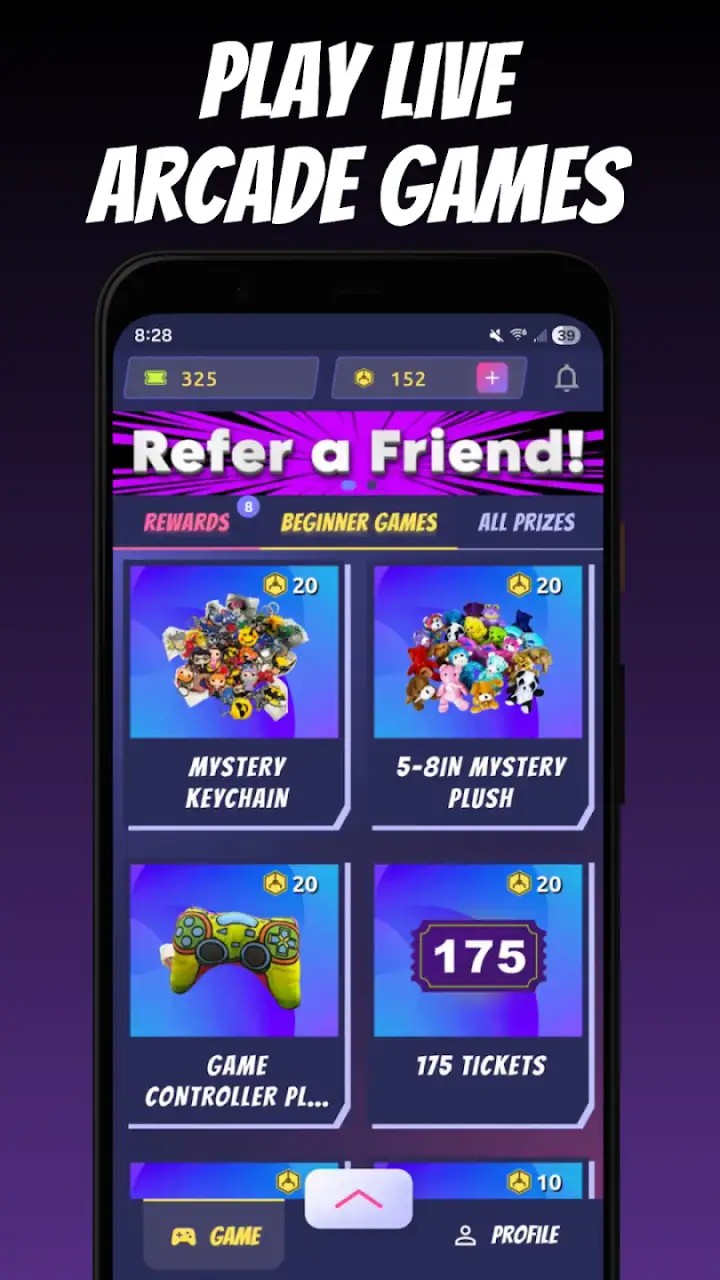
For casual use, I would set a personal stopping point before starting. That is especially important because the game includes in-app purchases ranging from $3.99 to $99.99 per item. The presence of those purchases does not automatically make the game unsuitable, but it changes how I evaluate the free experience. A player who wants a completely cost-free arcade routine should be prepared to ignore purchase prompts and accept a slower or less flexible session if that is how the game presents its opportunities.
My practical tip is to regard any free attempts or rewards as entertainment value, not as money already spent or money that must be recovered. That mindset keeps the first week enjoyable. It also makes the game’s main question clearer: do I like operating the virtual machines even when the outcome is not favorable? If the answer is no, the reward possibility will probably not provide lasting satisfaction by itself.
What remains valuable after the novelty fades
The month-to-month question is harder. The first few sessions benefit from discovery, but long-term value depends on whether the basic claw interaction continues to feel worthwhile. Unlike a traditional arcade game built around mastery, this experience is not primarily asking me to memorize enemy patterns, improve a route, or perfect a score. Its recurring appeal comes from anticipation, changing opportunities, and the emotional pull of a possible prize.
That can be enough for players who enjoy intermittent excitement. Someone who checks in occasionally may find that the game stays fresh because each visit is separated by normal daily life. A short session after several days away can feel more interesting than playing continuously for an hour. In that sense, the product is better suited to a light habit than to intensive daily grinding.
For me, the strongest long-term use case would be a scheduled, limited check-in. I could open it during a regular break, play only while the experience feels entertaining, and then leave. That approach protects the game from becoming a background compulsion. It also lets the reward element remain a bonus rather than turning every session into a test of patience.
The developer, CoinCrazy, has positioned the game around a recognizable arcade fantasy rather than a complicated genre blend. That clarity is a strength. I know what kind of experience I am opening, and I do not need to invest a large amount of time before understanding its purpose. The trade-off is that players looking for new mechanics, character progression, competitive ranking depth, or a substantial campaign may eventually feel that the core loop has reached its limit.
Compared with ordinary mobile arcade games, this one has a more tangible sense of consequence because the focus is on prizes rather than only virtual scores. Compared with a real-world claw machine, it is more convenient because I can access the experience from a phone instead of visiting an arcade. However, it cannot fully reproduce the physical atmosphere, tactile controls, or social feeling of standing beside a real machine. The digital format is convenient, but it also makes the interaction less memorable once the novelty has worn off.
Who is likely to keep opening it?
I think it has the best chance of becoming a regular app for people who already enjoy crane games and want a quick mobile version of that pastime. It may also suit players who like uncertain outcomes but do not want to learn complicated arcade systems. Families and younger users may appreciate the simple premise, although adults should still explain that a possible reward is not the same thing as a guaranteed result, particularly when purchases are available.
The Everyone content rating makes the game broadly approachable, but that should not remove the need for sensible boundaries. Younger players may focus on the prize language more than on the entertainment itself. I would use device purchase controls and agree on a clear limit before letting a child play. That is not a criticism unique to this title; it is simply the responsible way to handle any free game that offers paid items.
I would be less likely to recommend it to someone who wants a completely predictable skill challenge. If your favorite arcade games reward precise practice every time, the uncertain nature of claw machines may feel unfair. A conventional reflex game, puzzle game, or score-attack title will probably offer a clearer connection between improvement and success. This is a better choice for suspense than for pure mastery.
The maintenance burden of keeping it in a routine
Maintenance here is less about complex setup and more about managing attention. Because the game is built around repeated short visits, I would need to decide how often I want to check it and what counts as a satisfying session. Without that boundary, a quick arcade break can turn into repeated attempts driven by the desire to reverse an unlucky result.
I recommend separating three activities that can otherwise blur together: playing for fun, checking available opportunities, and considering a purchase. If I open the game only to relax, I should not make a spending decision in the same emotional moment. If I am evaluating whether an item is worth buying, I should do that calmly and remember that the purchase is for additional game participation, not a promise of a particular outcome.
The current version is 2.3.4, and the game supports devices running Android 7.0 or later. That makes it accessible on a wide range of older Android phones, although compatibility alone does not tell me how comfortable the experience will be on every screen size or connection. Since the game’s appeal depends on online arcade activity, I would prefer to play with a stable connection rather than treating it as a guaranteed offline time-killer.
Another maintenance point is storage in the broader sense: the game needs to earn its place on my home screen. I would keep it installed if I genuinely looked forward to occasional sessions, not merely because I had already invested time in it. If I stopped feeling curious about the available machines or rewards, removing it would be reasonable. The free installation makes that decision easy because there is no need to preserve it out of commitment.
I also would not build a daily schedule around winning. A healthy routine is to decide the time and spending limit first, then stop when either limit is reached. That makes the product function like a small entertainment break instead of a task that demands completion. The distinction is subtle, but it has a major effect on whether the game remains pleasant over several months.
Where fatigue begins
The biggest source of fatigue is repetition. The claw-machine concept is instantly readable, but that also means the game has less room to surprise me through conventional progression. If several sessions produce the same emotional pattern—hope, attempt, disappointment, repeat—the reward framing can start to feel like pressure rather than fun.
Uncertainty is another dividing line. Some players enjoy not knowing whether a grab will succeed, while others want outcomes to reflect their decisions more directly. In a physical claw machine, the uncertainty is part of the atmosphere. On a phone, repeated misses can feel more abstract because I am not physically manipulating a machine or watching a prize move in front of me. The convenience of the digital format therefore comes with a loss of tactile satisfaction.
Paid items can add friction even for players who never buy them. The listed range reaches from a small purchase to a much larger one, so I would pay attention to how easily the game interrupts the arcade flow with spending decisions. My advice is simple: disable or protect purchases if the device is shared, and never treat a near miss as a reason to spend more. A near miss is still an unsuccessful attempt, not evidence that the next attempt will work.
The reward promise can also overshadow the game itself. If I judge every session only by whether I receive something valuable, I am likely to become dissatisfied quickly. The better test is whether the act of playing remains enjoyable when the result is ordinary. Players who cannot answer yes to that question should probably choose a conventional arcade title with no purchase-related tension.
There is also a social expectation that comes with a product described as an online arcade. I may imagine a bustling shared space, but the core experience can still be solitary from my perspective. That is not necessarily a flaw, yet it matters when deciding what kind of entertainment I want. For social play, a multiplayer arcade game with direct interaction may be a better fit. For private, short suspense, this format makes more sense.
Small habits that improve the experience
I found three habits especially useful. First, I would play in short sessions rather than trying to extract maximum value from one long visit. The format is naturally better at creating a quick moment of anticipation than sustaining an extended campaign.
Second, I would keep a simple personal record of spending and stop dates if I choose to make purchases. This is not about turning entertainment into accounting; it is a way to prevent several small decisions from becoming invisible over time. Since items can cost substantially different amounts, relying on memory alone is not a good safeguard.
Third, I would judge the game over several separate visits, not one lucky or unlucky session. A single successful attempt can make the experience seem deeper than it is, while a short run of misses can make it seem completely pointless. Looking at my own enjoyment across time gives a fairer answer about whether it deserves regular space.
My long-term verdict
ClawCrazy is a focused arcade game with a clear hook: it turns the familiar claw-machine moment into a mobile activity connected to real rewards. CoinCrazy keeps the basic idea easy to understand, and the free entry makes it simple to test without a major commitment. Its broad audience positioning and more than one hundred thousand installs show that the concept has found an audience, while the strong rating indicates that many players enjoy the format.
My recommendation depends on what you want from a game. If you enjoy crane machines, short sessions, uncertain outcomes, and the extra excitement of possible prizes, this is worth trying. I would install it as a casual side activity and give it a fair chance during the first week, while setting purchase boundaries before the novelty becomes persuasive.
I would skip it if I need deep progression, reliable skill-based improvement, offline independence, or a game that feels equally satisfying after every session. A traditional arcade title will usually be better for those needs because its rewards are clearer and its long-term challenge is easier to measure.
After the first month, I would keep it only if the machines themselves still entertain me. That is the decisive test. The possibility of a reward can bring me back, but it cannot permanently replace engaging play. The lasting value comes from treating the prize as an extra, not as the entire reason to open the game.
With that mindset, the game earns a modest place in my mobile rotation: not a main game, not a guaranteed daily habit, but a convenient arcade diversion for carefully limited sessions. It is most enjoyable when I remain in control of the pace and the budget. Used that way, it delivers a distinctive kind of quick suspense; used as a constant chase, it is much more likely to become tiring.
FAQs for ClawCrazy: Play, Grab & Win
What is ClawCrazy: Play, Grab & Win?
ClawCrazy: Play, Grab & Win is a mobile claw-machine game that lets you control virtual arcade machines, aim for prizes, and try to win rewards through timed gameplay. The app focuses on the familiar grabber-machine experience, with touch controls for positioning the claw and attempting a successful grab. Before downloading, users should check the current prize availability, regional access, and the app’s latest terms.
How does the gameplay work in ClawCrazy: Play, Grab & Win?
After selecting an available machine, you generally control the claw by moving it into position and activating it at the right moment. Success depends on timing, alignment, and the strength or design of the selected machine. The experience is simple to understand, but grabbing prizes may require practice. New players should review any instructions, entry requirements, and available credits before starting a session.
Can players really win physical prizes with ClawCrazy?
ClawCrazy is designed around the possibility of winning prizes from claw-machine challenges, but winning is not guaranteed. Prize types, eligibility rules, stock, shipping availability, and redemption procedures may vary depending on location and current promotions. Users should read the official prize and fulfillment information carefully, including whether delivery fees, age restrictions, verification, or geographic limitations apply before spending credits or making a purchase.
Is ClawCrazy: Play, Grab & Win free to download and play?
The application may be free to install, but some gameplay features, attempts, credits, or prize-related activities can involve in-app purchases or other costs. The exact pricing and available payment options may change over time and by region. Parents should also review the app’s purchase settings if children use the device. Checking the store listing and in-app payment details is recommended before beginning.
Is ClawCrazy safe and suitable for children?
ClawCrazy should be evaluated according to its current age rating, privacy policy, permissions, advertising practices, and in-app purchase options. Although the claw-machine format is easy to understand, prize-based play and paid attempts may not be suitable for every child. Adults should supervise younger users, enable purchase protections, and confirm how personal information, payment data, and shipping details are handled.
Pros
- Simple controls make the claw games easy to learn.
- Prize variety keeps the experience interesting for different players.
- Bright graphics and playful sounds create an entertaining atmosphere.
- Short sessions work well for quick breaks or casual play.
- Regular challenges can add extra motivation to return.
Cons
- Winning prizes may require patience and repeated attempts.
- Some rewards or features may be limited by location.
- The app can feel repetitive after extended play sessions.
- An internet connection may be needed for core functionality.
- Advertisements or in-app purchases may interrupt the experience.


